 What to eat on the street in Vietnam, and how
Independent street food guide
Street food in Vietnam, explained before you sit down
A practical guide for visitors who want to eat where people in Vietnam eat: on low plastic stools, at one-dish stalls, in market food halls. What each dish is, how to order it without a menu, what it should cost in each city, and how to keep your stomach on side. Every price carries the date we checked it.
What this guide is for
Most visitors to Vietnam end up eating street food sooner or later, often on the first evening. The difficulty is rarely the food itself. It is the moment before: a stall with no menu, a pot of broth, a pile of herbs, a woman who asks you something in Vietnamese, and no price anywhere. This guide is written for that moment.
It covers five things. What the common dishes are, where they come from and what is in them, including the ingredients that matter for allergies. How a stall works, from sitting down to paying. What a bowl or a sandwich costs in Hanoi, Hue, Hoi An and Ho Chi Minh City, with the date we checked each figure. How to lower the risk of stomach trouble. And how to eat vegetarian, vegan, halal or gluten-free when the default is pork, fish sauce and shrimp paste.
Dish glossary
Pho, bun cha, banh mi, banh xeo, com tam, bun bo Hue, cao lau, mi Quang and more: origin, ingredients and allergy flags in one table. Open the glossary.
How to eat at a stall
Stools, shared tables, the herb basket, the sauces on the table and how to pay without a menu. Read the walk-through.
Prices by city
Price ranges for common dishes in four cities, each with a source and a check date, and how overcharging works. See the price tables.
Food safety
What official health advice says about street food, ice, raw herbs and methanol, and what to do when your stomach turns. Read the safety page.
Vegetarian and dietary needs
An chay, vegan, halal, gluten-free and allergies: the words to use and the hidden ingredients to ask about. Read the dietary page.
City by city
Hanoi, Hue, Hoi An with Da Nang, and Ho Chi Minh City: what is eaten when, and when not to plan around food. Compare the cities.
Five things that surprise first-time visitors
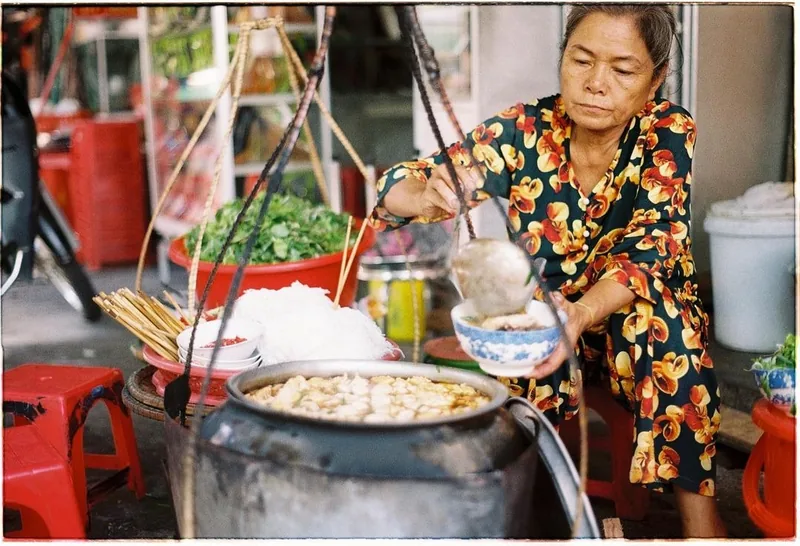
- Many stalls sell one dish. A sign that says pho bo or bun cha is usually the whole menu. You sit, hold up fingers for how many, and the bowls arrive. Pointing at what the next table is eating works.
- Time of day decides what you can eat. In Hanoi, bun cha is a lunch dish and many stalls close by about 2 pm. In Hue, bun bo Hue is mainly a morning bowl and good vendors often sell out by about 10 am. Arrive at the wrong hour and the stall is a pile of stacked stools.
- The herbs are part of the dish, not a garnish. In mi Quang the herbs can fill nearly half the bowl. In bun cha they are eaten with every bite. They are also the part of the meal most often eaten raw, which matters for food safety.
- Prices are low but not fixed. A bowl of pho, bun or mien in Hanoi commonly costs VND 40,000 to 50,000 (July 2026). Cases of tourists being charged several times that amount make the news every year. Asking the price first solves most of it.
- Fish sauce and shrimp are in almost everything. That matters for vegetarians, for anyone with a shellfish or fish allergy, and for people avoiding particular foods for religious reasons.
Sources: vietnamtourism.com (independent guide) — bun cha and how to eat it; vietnamtourism.com (independent guide) — Hue food scene; Da Nang Tourism Promotion Center — Quang noodles; VietNamNet — Hanoi pho and rice platter prices (July 2026); VnExpress International — Vietnam tourism struggles to prevent overcharging (March 2026) · last checked .
How the four cities differ
Vietnamese food is regional, and the street food changes as you travel. Northern cooking is lighter on chilli and uses black pepper more; central cooking is the spiciest, with chilli and shrimp sauces; southern cooking leans sweeter, with more sugar and coconut milk. A bowl of pho in Hanoi and one in Ho Chi Minh City are different experiences: clear and restrained in the north, sweeter and loaded with bean sprouts, basil and hoisin in the south.
Hanoi is a city of noodle soups and grilled pork at lunch. Hue, the old imperial capital, eats small steamed rice cakes and a spicy beef noodle soup named after the city. Hoi An, now a ward of Da Nang city, has cao lau, a noodle dish tied to the town itself, and the surrounding area has mi Quang. Ho Chi Minh City has the widest range of all, from broken-rice plates at breakfast to banh mi at any hour.
Sources: Wikipedia — Vietnamese cuisine; Wikipedia — Pho; Wikipedia — Hoi An (2025 ward status) · last checked .
How this guide works
Every page that contains a price, an opening time or a rule has a source line under the section, with a date marked last checked. That is the day an editor read the source, not the day the site was rebuilt. Official sources come first: the city tourism authorities in Hanoi and Da Nang, the Vietnam National Authority of Tourism, the government news portals, and the health advice of the UK Foreign Office, the US CDC and the World Health Organization. Where only a newspaper or an independent guide gives a figure, the source line says so.
Prices on the street change quickly. Hanoi eateries raised some bowls by VND 5,000 in 2026, and Ho Chi Minh City eateries reported rises of VND 3,000 to 20,000 a dish in March 2026. Treat every figure here as a range to check, not a price list. If you find something different, the contact page is the way to tell us.
The guide does not sell food tours, take bookings, or recommend, rank or rate named stalls and restaurants. It names streets, markets and districts where that helps you find a type of food, and nothing more. There is no paid placement in the text. Advertising spaces on the site carry the label Advertisement and sit apart from the editorial content; the about page explains the policy.
Sources: VietNamNet — Hanoi pho and rice platter prices (July 2026); Tuoi Tre News — Ho Chi Minh City eateries edge up prices (March 2026) · last checked .
A short glossary to carry
| Word | Meaning | Where you see it |
|---|---|---|
| Bun | Round rice vermicelli | Bun cha, bun bo Hue, bun rieu |
| Pho | Flat rice noodle soup, usually beef (bo) or chicken (ga) | Pho bo, pho ga |
| Com | Cooked rice; also means a meal | Com tam, com ga |
| Banh | A broad word for cakes, breads and pancakes | Banh mi, banh xeo, banh beo |
| Chay | Vegetarian | Com chay, pho chay, banh beo chay |
| Nuoc mam | Fish sauce | In most dipping sauces and many broths |
| Mam tom | Fermented shrimp paste | Strong-smelling dip in the north |
| Bao nhieu tien? | How much is it? | Ask before you order |
Vietnamese is a tonal language and the spellings above leave out the accents, so pronunciation will be off. Pointing and holding up fingers is understood everywhere; writing the dish name on your phone works too. The dish glossary has the full list with origins and allergy flags.
Sources: Wikipedia — Vietnamese cuisine; vietnamtourism.com (independent guide) — banh beo and how to order it · last checked .
Who this guide is not for
- Readers who want a list of named stalls to queue at. We do not publish one, and we do not rank or rate stalls.
- Anyone looking to book a food tour or cooking class. Nothing here is for sale.
- Fine dining and restaurant reviews. The guide stays on the street, in markets and at simple eateries.
- Readers who need medical advice for a specific condition. The food safety page summarises official travel health advice; a travel clinic or doctor should advise you personally.
Common questions
Questions readers ask
Is street food in Vietnam safe to eat?
Most visitors eat it without problems, but the risk is not zero. Official health advice says food that is fully cooked and served hot is the safest choice, and that raw vegetables and ice are riskier. The food safety page explains how to apply that at a stall.
How much money do I need for a day of street food?
In 2026 a bowl of noodle soup on the street commonly cost VND 40,000 to 60,000 in Hanoi and Hue, and a banh mi from a street cart about VND 20,000 in Ho Chi Minh City. Three street meals and a few snacks usually stay well under VND 300,000, but check the prices page for the ranges and their dates.
Do you recommend particular stalls?
No. The guide explains dishes, prices and how to order, and names streets and markets, but it does not recommend, rank or rate named stalls or restaurants.
Can I eat street food as a vegetarian?
Yes, with some effort. Look for the word chay, which means vegetarian, and ask about fish sauce and shrimp, which are used in many dishes that look meat-free. The vegetarian and dietary needs page lists the phrases.
Related
Read next
Understand · Dishes
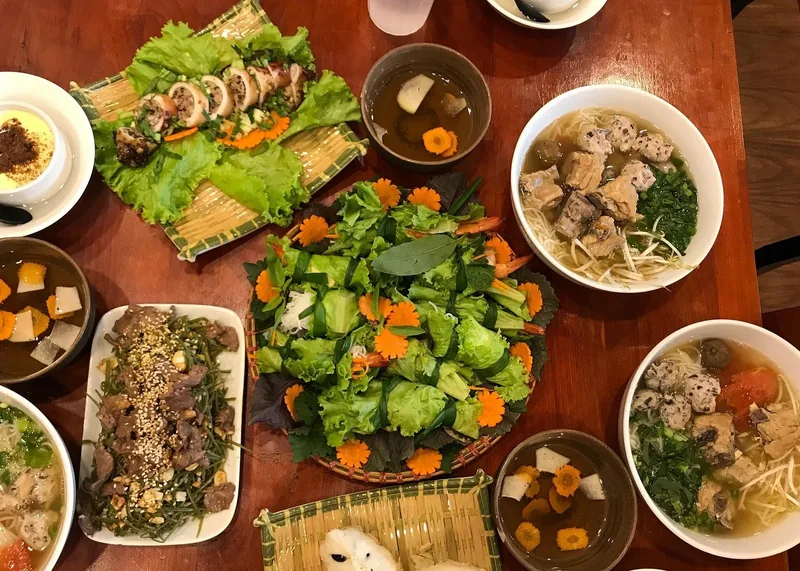
Dish glossary
What the common street dishes are, where they come from and which allergens they usually contain.
Read more
Understand · Ordering
How to eat at a stall
Choosing a stall, sitting down, ordering without a menu, using the herbs and sauces, and paying.
Read more
Understand · Prices
Prices by city
Price ranges for street dishes in five cities, with sources and dates, plus how to avoid being overcharged.
Read more
Understand · Health
Food safety
Official health advice on street food, ice, raw herbs and methanol, applied to real stalls, and what to do if ill.
Read more
Understand · Diets
Vegetarian and dietary needs
An chay, vegan, halal and gluten-free street eating: hidden ingredients, the words to use and where to look.
Read more
Cities
Cities
How street food differs between Hanoi, Hue, Hoi An with Da Nang, and Ho Chi Minh City.
Read moreStart planning
Send a correction or a question
Tell us which page you mean, what you found at the stall or in the market, and when. A price, a date and a city help us check it.